Stories

Main Content
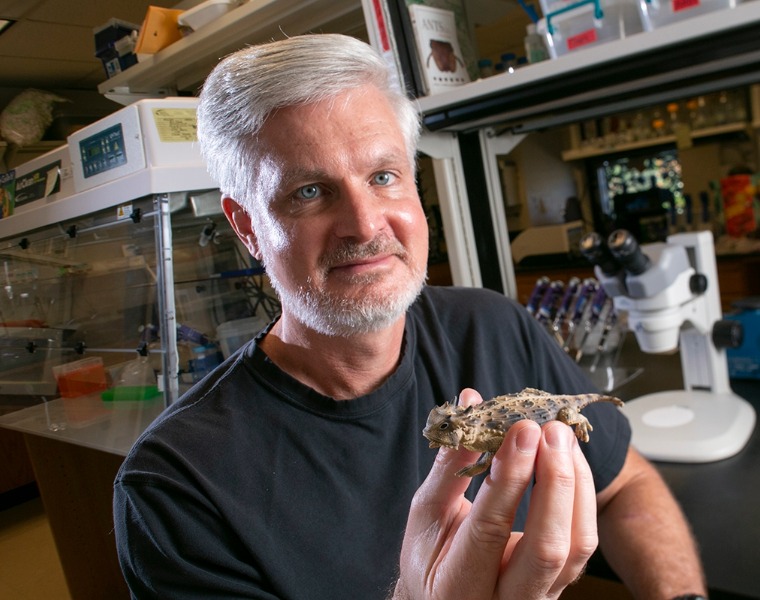
Dean Williams and a horned frog
Featured

Horned Frogs Explained in 60 Seconds

Dean Williams, environmental science professor, talks about horned frogs.

Dean Williams holding a Horned Lizard

Dean Williams Explains Significance of Rare Texas Horned Lizard Discovery

A newly discovered Texas horned lizard could mark an important milestone in conservation efforts, and TCU biology professor Dean Williams shared his expertise in a recent Yahoo News story about the find.

July 7, 2026
Dean Williams and a horned frog

Horned Frogs Explained in 60 Seconds

Dean Williams, environmental science professor, talks about horned frogs.
April 24, 2026, by McKenzie Lane
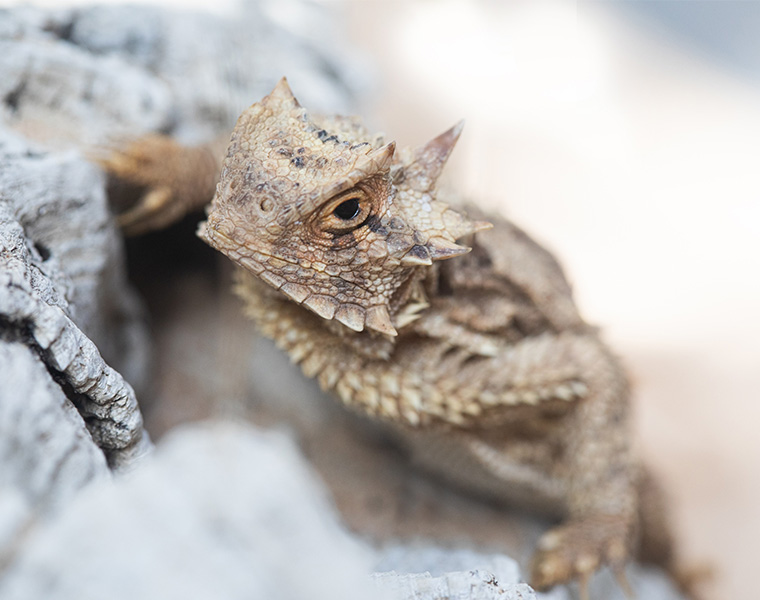
Horned Frog

TCU's Research Helps Fort Worth Zoo Release Record Number of Texas Horned Lizards

TCU’s "Horny Toad Project," led by biology professor Dean Williams, Ph.D., has played a critical role in the Fort Worth Zoo’s record-breaking release of 617 Texas horned lizards into the wild.

December 9, 2024, by Abriana Nader
stewartsmall

Biology Professor Mikaela Stewart Conducts Groundbreaking Breast Cancer Research

One in eight women in the United States will be diagnosed with breast cancer in her lifetime. It is the most common cancer among women globally, with more than 2 million new cases each year according to the Susan G. Komen Foundation. TCU biology professor Mikaela Stewart is innovating the way we research breast cancer in efforts to transform these harrowing statistics into stories of victory.

May 19, 2023, by Audrey Klinefelter
setac small

Exploring Mercury, Invertebrates, Spiders, and Minnows Take CSE Students to Victory

CSE faculty and students traveled to Pittsburgh in November to present in the North American meeting of the Society of Environmental Toxicology and Chemistry (SETAC), with two works receiving awards.

February 20, 2023, by Audrey Klinefelter
horner-carnivorous-plants-small

Meat-Eaters of the Plant World

Carnivorous plants have a wild array of adaptations that help them flourish in nutrient-poor environments, which include strategies to lure prey to their traps. John Horner, TCU biology professor, is an evolutionary ecologist with research interests in plant-insect interactions. Here he answers some in-depth questions about these fascinating plants.

November 8, 2022
dragonflyprojectsmall

Using Parks as Classrooms

Biology graduate student, Kimberlee Whitmore, biology alumna, Maddy Hannappel, and Matt Chumchal, biology professor and director of the Pre-Health Professions Institute, worked with a team of high school students and their teacher, Andrew Brinker, from the Texas Academy of Biomedical Sciences. They collected dragonflies for the Dragonfly Mercury Project at the Fort Worth Nature Center and Refuge.

October 14, 2022
earthdaysmall

Earth Day 2022: Conservation and Preservation Story Roundup

TCU is involved in conservation and preservation efforts. This Earth Day, we look back at stories on how the College of Science & Engineering is making an impact, both locally and globally.

April 22, 2022
rip-spider-small

Journal Publishes Research Results by TCU Biology Professor, Matt Chumchal, Analyzing the Use of Riparian Spiders as Sentinels of Contaminants in Aquatic Ecosystems

Matt Chumchal, TCU professor of biology, along with eight coauthors, recently had a paper, "Use of Riparian Spiders as Sentinels of Persistent and Bioavailable Chemical Contaminants in Aquatic Ecosystems: A Review," published in Environmental Toxicology and Chemistry (ET&C), an international scientific journal. The article reviews the use of riparian spiders as sentinels of environmental pollution, and suggests the development of national-scale programs to monitor chemical contaminants in aquatic ecosystems using spiders.

February 2, 2022

Recent Posts